Furniture dollies & platform trolleys
Four-wheel dollies allow heavy furniture, cartons and equipment to roll across suitable flat surfaces rather than being carried the full distance.
Professional moving is not just about strength. The right equipment reduces manual handling, protects furniture and property, improves control on stairs and helps crews plan the job before the truck arrives.
Examples from our moving photo collection. Your move is planned around your own inventory and access.

Most successful moves combine simple mechanical aids with good planning. Safe Work Australia recommends eliminating or minimising hazardous manual tasks where reasonably practicable and specifically points to mechanical aids as one way to reduce manual handling risk.
Four-wheel dollies allow heavy furniture, cartons and equipment to roll across suitable flat surfaces rather than being carried the full distance.
Useful for stacked cartons, appliances and tall loads. Straps and suitable wheels help keep the load controlled while moving between the property and truck.
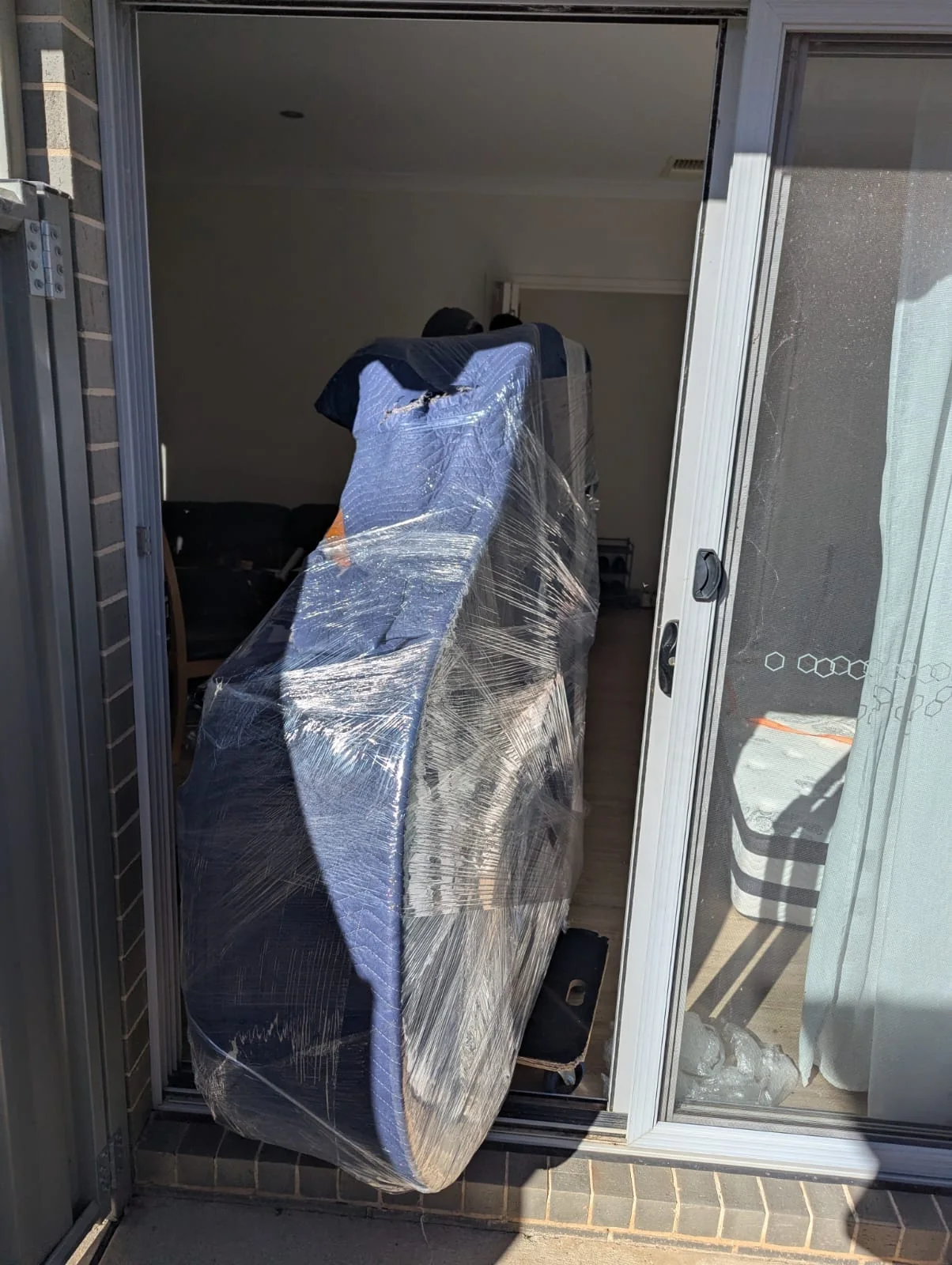
Padding helps protect furniture finishes and reduces rubbing between items in the vehicle. Door jamb, wall and floor protection can also be important in apartments and high-traffic buildings.
Commercial lifting straps can help two people control bulky furniture while staying more upright. Manufacturers such as ShoulderDolly design harness systems to shift more of the load toward the legs and shoulders.
Mechanical loading aids reduce the need to manually lift heavy loads between ground level and the truck deck. The exact equipment depends on the vehicle and job.
Hex keys, screwdrivers, sockets, drills, labels and small hardware containers help with furniture disassembly and reassembly. Parts should be kept organised and matched to the correct item.
Battery-powered stair-climbing hand trucks are one of the most useful developments for heavy or awkward loads on stairs. PowerMate's powered stair climbers use motorised lift systems and automatic braking, while Australian suppliers also offer lighter powered stair-climbing trolleys for logistics, appliance delivery and removalist work.
A powered stair climber does not make every staircase safe or every item suitable. Stair width, turns, landings, load shape, weight distribution and operator training still matter. A crew should assess the actual route before relying on the equipment.
Examples: PowerMate powered stair climbers and Sala powered stair-climbing trolley.
Air-bearing systems create a thin film of air beneath a load so large appliances or equipment can be moved with much lower rolling resistance. Airsled's AirDolly products, for example, are designed to move heavy household items using low-pressure air-film technology.
Moving inventory apps can create a visual record of boxes and furniture, attach photos and details, and use barcodes or QR codes so a box can be scanned later to see what is inside. Sortly, for example, supports QR/barcode inventory and moving-specific organisation.
Record rooms, important items and condition photos.
Assign each box a label or QR code and note the destination room.
Scan or check the inventory so boxes can be placed in the correct room and missing items are easier to identify.
One of the newer developments in the moving industry is the Photo-assisted virtual survey. A customer records a guided smartphone walkthrough, and software identifies furniture and builds an inventory or cube sheet for the estimator to review. Platforms such as Movegistics/HomeSurvey.digital, Virtual Estimate and Yembo now market Photo-based moving surveys.
The customer can show the actual furniture, rooms, stairs, lifts and access without waiting for an estimator to drive to the property. This can make early quoting faster and create a better inventory than a short phone description.
Photo assessment can miss items, misunderstand access or estimate dimensions incorrectly. For unusual furniture, pianos, fragile items and difficult access, photos, measurements or a human review may still be needed before confirming the job.
Examples: Movegistics Virtual moving surveys, Virtual Estimate Video estimates and Yembo moving surveys.
Fleet software is also becoming more sophisticated. Australian delivery platforms such as Locate2u combine route optimisation, live GPS tracking, customer ETA links and digital proof of delivery. While removal jobs differ from parcel delivery, the same technology can help moving companies coordinate crews, routes and customer communication.
Route engines can account for traffic, time windows, vehicle capacity and multiple stops.
Customers can receive clearer arrival information while dispatch can see where vehicles are.
Photos, signatures, timestamps and notes can create a clearer job record.
The right equipment depends on the property. A straightforward driveway-to-driveway house move may mainly need dollies, blankets, straps and a suitable truck. A high-rise apartment in Belconnen, Woden, Braddon or Kingston may require lift bookings, basement clearance checks, longer carries and compact trolleys. A piano or heavy item may require additional protection, specialised skids, powered equipment or more crew.
Safe Work Australia says hazardous manual tasks can involve repetitive or sustained force, high or sudden force, repetitive movement and awkward postures. Mechanical aids are one control option, but businesses still need to identify hazards, assess the risks and manage them appropriately.
Safe Movers note: the equipment used for a job depends on the item, property access, crew and vehicle. This article describes common industry tools and newer technology; it is not a promise that every listed device will be used on every Safe Movers booking.